Tuesday, May 3, 2016

Identifying “the Spirits in Prison”

Biblegems #267

Question: Who are the “spirits in prison” mentioned in 1 Peter 3:18-19, and what was “preached” to them?

Here is the passage in both the KJV and the NIV (2011), with the most pertinent section underlined:
         1Pet. 3:18-19   For Christ also hath once suffered for sins, the just for the unjust, that he might bring us to God, being put to death in the flesh, but quickened by the Spirit: By which also he went and preached unto the spirits in prison (KJV).      

1Pet. 3:18-19 For Christ also suffered once for sins, the righteous for the unrighteous, to bring you to God. He was put to death in the body but made alive in the Spirit. After being made alive, he went and made proclamation to the imprisoned spirits (NIV).

Interpretations of this passage have historically fallen into three general categories:
Interpretation #1       Between his crucifixion and resurrection, Jesus went to the realm of the dead in spiritual form and preached to Noah’s contemporaries. Some in this group believe Jesus offered salvation to the spirits of those who died in the Flood. Others in this group believe Jesus’ proclamation was to officially condemn the unbelievers of Noah’s time. A third view within this group is that Jesus preached good news to those of Noah’s day who had already been saved.

         Interpretation #2       Jesus, in His pre-existent, spiritual state, came from heaven to the sinful generation of Noah’s day and preached repentance, which they ignored.

         Interpretation #3       After His death on the cross and burial, Jesus went in the Spirit (either Holy Spirit, or in the spiritual realm) to the disobedient spirits (fallen angels) of Noah’s day, described in Genesis 6:1-4, and proclaimed his victory over sin and death.

The word “spirits” in Scripture can refer to humans, angels, God, or the demonic. Context generally determines what kind of spirit is in view. The context of 1Pet. 3:20 makes it clear that Jesus made His proclamation to spirits “who were disobedient long ago in the days of Noah….” Jude also refers to this same group of imprisoned spirits as “angels who did not keep their positions of authority but abandoned their proper dwelling—these he has kept in darkness, bound with everlasting chains for judgment on the great Day” (Jude 6).

The New Testament, then, points to a specific group of angels who are imprisoned by God until the Day of Judgment for their disobedience in the days of Noah. These spirits are not in hell (Gk. gehenna), which is currently empty (Rev. 20:10ff.), but in a special prison called Tartarus:
         2Pet. 2:4   For if God did not spare angels when they sinned, but sent them to hell (Gk. tartarus), putting them in chains of darkness to be held for judgment…

The only such distinct group described in Scripture in Noah’s day would appear to be “the sons of God who went to the daughters of humans and had children by them” (Gen. 6:4). Following His crucifixion, Jesus was made alive in the Spirit and went to these imprisoned angels, proclaiming His victory over sin, Satan and death!

Tuesday, April 12, 2016

Giants—Revisited Part 2, “Sons Of God”—The Line Of Seth?


Biblegems #266
Note: Bible Gems post #264, “Giants—Myth or History,” generated some excellent questions. Giants—Revisited Part 2 continues to explore these questions. While Bible Gems is not a debate forum, questions and comments are welcome and will be posted at the moderator’s discretion.


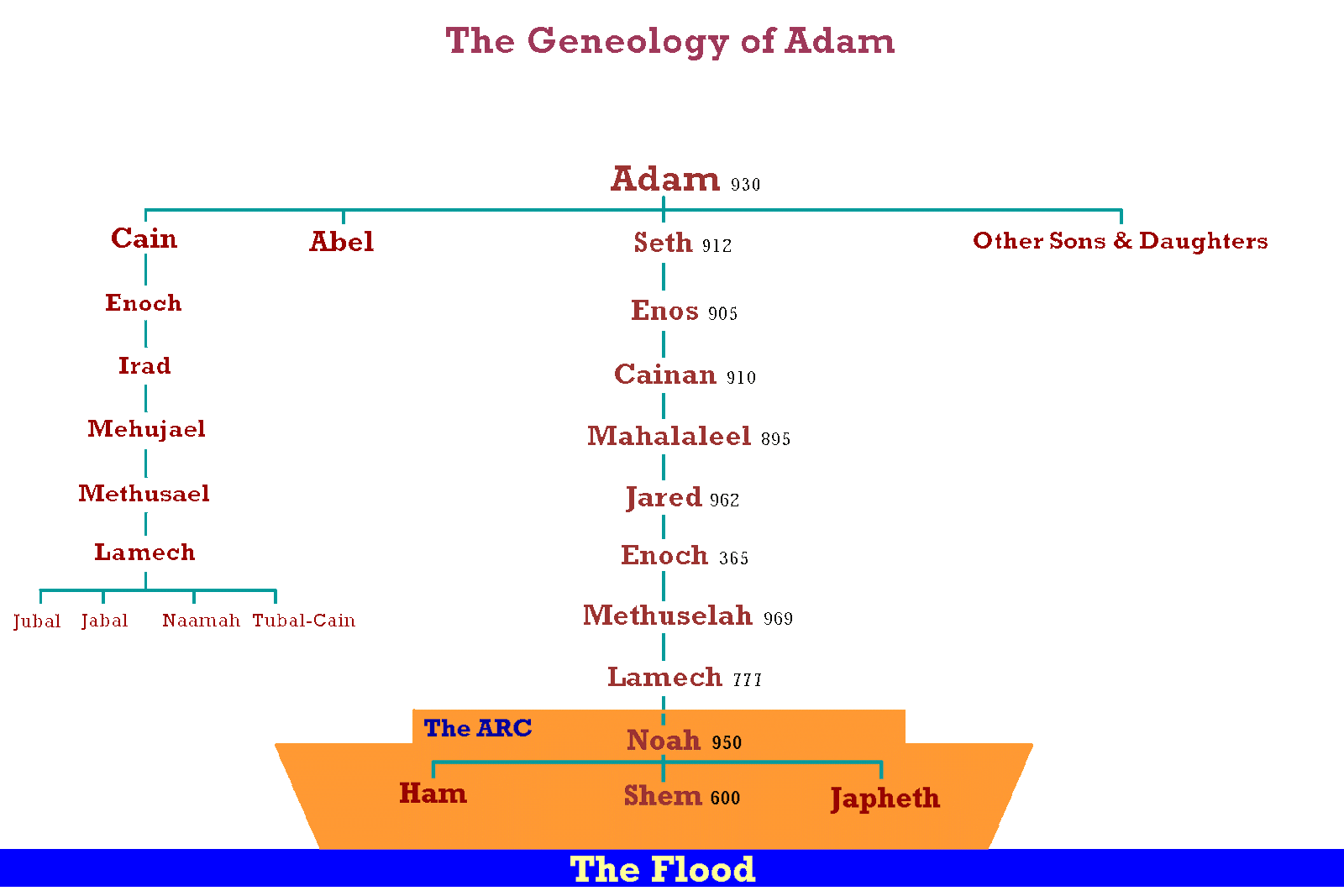
Question: Could the reference to the "sons of God" in Genesis 6:1-4 (v.2) refer to the line of Seth instead of disobedient angels, and the daughters they married refer to the line of Cain? Wouldn’t that better explain God's grief over their inter-marriage because the line of Cain’s unrighteous descendants compromised Seth’s righteousness line?

This was the position taken by John Calvin, among others, who wrote: “It was, therefore, base ingratitude in the posterity of Seth, to mingle themselves with the children of Cain” —EBC, in loc.

This interpretation assumes that Scripture has clearly defined Seth’s family tree as a “holy line” and Cain’s family tree as an “unholy line.” While it is true that Genesis 4:25 through 5:32 develops the ancestry of Noah (5:29-32) all the way back to Adam and Eve’s son, Seth (Gen. 4:25), nothing is taught in these verses concerning a “holy” / “righteous” line versus an “unholy” / “unrighteous” line.

More importantly, the wording in Genesis 6:1-2 is intended to convey an obvious contrast between the “sons of God” and the “daughters of men” that resulted in the appearance of the “Nephilim” (a race of giants, as we saw in Biblegems #264) — “the heroes of old, men of renown” (v.4). The phrase “sons of God” is never used in the Old Testament of the line of Seth, before or after Genesis 6. “Sons of God” is consistently used in the Old Testament, however, in reference to angels, beginning with the book of Job—arguably one of the oldest books of the Old Testament:
Job 1:6  Now there was a day when the sons of God came to present themselves before the LORD, and Satan also came among them.

“Sons of God” here in Job, typical of Old Testament usage, clearly refers to angels. Not only so, but the wording of Genesis 6:1-2 in Hebrew conveys a sharp contrast between the “sons of God” (Heb. “benei ha elohim”) and “the daughters of humans” (Heb. “benot ha adaham”). A tightly literal translation of Genesis 6:1-2 reads:
         “When Adamites began to increase on the face of the earth and daughters were born to them, the sons of Elohim saw the daughters of Adam were pleasant and they took (Heb. yiqchu) any of them they chose.”

The most natural, straightforward reading of the text contrasts the “sons of God” with the “daughters of men” as those representing two different lines of origin, not two lines of Adam.

Both the context and terminology strongly favor the interpretation of “sons of God” as referring to angels, not descendants of Cain. And while this creates other issues scientifically and theologically, those issues also find their answer in God’s Word. We will explore some of these difficulties in future posts. And as we do, we will keep before us this guiding principle: biblical interpretation is not the handmaiden of science.  Science ceases where observation cannot go and experimentation is no longer possible. God’s Word reveals the truth. At times, the truth and scientific understanding seem at odds. When that is the case, the truth will always win out and science may catch up…or not.
         Deut. 29:29  The secret things belong to the LORD our God, but the things revealed belong to us and to our children forever, that we may follow all the words of this law.

Tuesday, April 5, 2016

Giants—Revisited, Part 1, “Are Angels Sexless?”

Biblegems #265


Question: On identifying the “sons of God” (Gen. 6:1-4) as angels:

Is it not the clearer indication in Matthew 22:30 from our Lord that angels are sexless? Is there any Biblical reference to the ability of angels to have sex at all, let alone match human chromosomes? Where does it say that the sons of God were fallen angels? Where does it say that angels can impregnate?

There are three theories on the identity of the “sons of God” in Genesis 6:1-4, all of them controversial.

Theory 1: Fallen Angels
Theory 2: Godly descendants of Seth
Theory 3: Dynastic Rulers (Dynastic Rulers is the weakest, biblically.)

Identifying the “sons of God” as fallen angels has been a widely held position throughout church history.[i]

This has been challenged in recent times, based on the theory that angels are sexless, incapable of interbreeding with humans. Billy Graham popularized this theory in his book, “Angels: God’s Secret Agents.”[ii] He interprets Matthew 22:30 to mean: “The Bible teaches that angels are sexless.” Here is the passage:
         Matt. 22:30  At the resurrection people will neither marry nor be given in marriage; they will be like the angels in heaven.

This verse actually says nothing regarding angel gender or biology. What Jesus teaches here is that there will be no marriage ceremonies among the resurrected people of God, just as there are no marriage ceremonies for angels.

To assume this means that angels and resurrected humans are sexless goes beyond the meaning of the text. The Bible teaches that God designed the male / female nature of mankind as an “image” in the created realm of God, who is Spirit (Gen. 1:27). Nowhere does Scripture suggest that humanity becomes gender-neutral in the resurrection.

Additionally, the term “sons of God” is used only of angels in the Old Testament (Job 1; Job 38:7; Ps. 29:1; Ps. 89:7). The Septuagint (Greek translation) of Genesis 6:1-4 translates “sons of God” as “angels.” In the New Testament, Jude 6-7 specifically mentions “…the angels who did not keep their positions of authority but abandoned their proper dwelling—these he has kept in darkness, bound with everlasting chains for judgment on the great Day. In a similar way, Sodom and Gomorrah and the surrounding towns gave themselves up to sexual immorality and perversion. They serve as an example of those who suffer the punishment of eternal fire.”

Only Genesis 6:1-4 matches Jude’s description of angels committing immoral acts similar to that taking place in Sodom and Gomorrah.

Peter also refers to these disobedient “spirits” that God has since ”imprisoned”:
         2 Pet. 3:19-20 “…the imprisoned spirits—to those who were disobedient long ago when God waited patiently in the days of Noah while the ark was being built.”

Finally, angels often change into human form in Scripture. Who is to say that genetic duplication is not involved, especially given the biblical evidence above supporting the interpretation that the “sons of God” are fallen angels?

How appropriate that Jesus “…has gone into heaven and is at God’s right hand with angels, authorities and powers in submission to him” (1Pet. 3:22).


[i] Supported by Philo, Josephus, Justin, Ambrose, the apocryphal book of Enoch, Delitzsch, Driver, Cassuto, Henry Morris, von Rad, Speiser. See: Chronological and Background Charts of the Old Testament, 1978, The Zondrvan Corporation. Pg. 35

[ii] Angels: God’s Secret Agents. Billy Graham, Doubleday & Company, Inc. Garden City, New York. 1975. pg 33