Biblegems #266
Note: Bible Gems post #264, “Giants—Myth or History,” generated some
excellent questions. Giants—Revisited Part 2 continues to explore these
questions. While Bible Gems is not a debate forum, questions and comments are
welcome and will be posted at the moderator’s discretion.
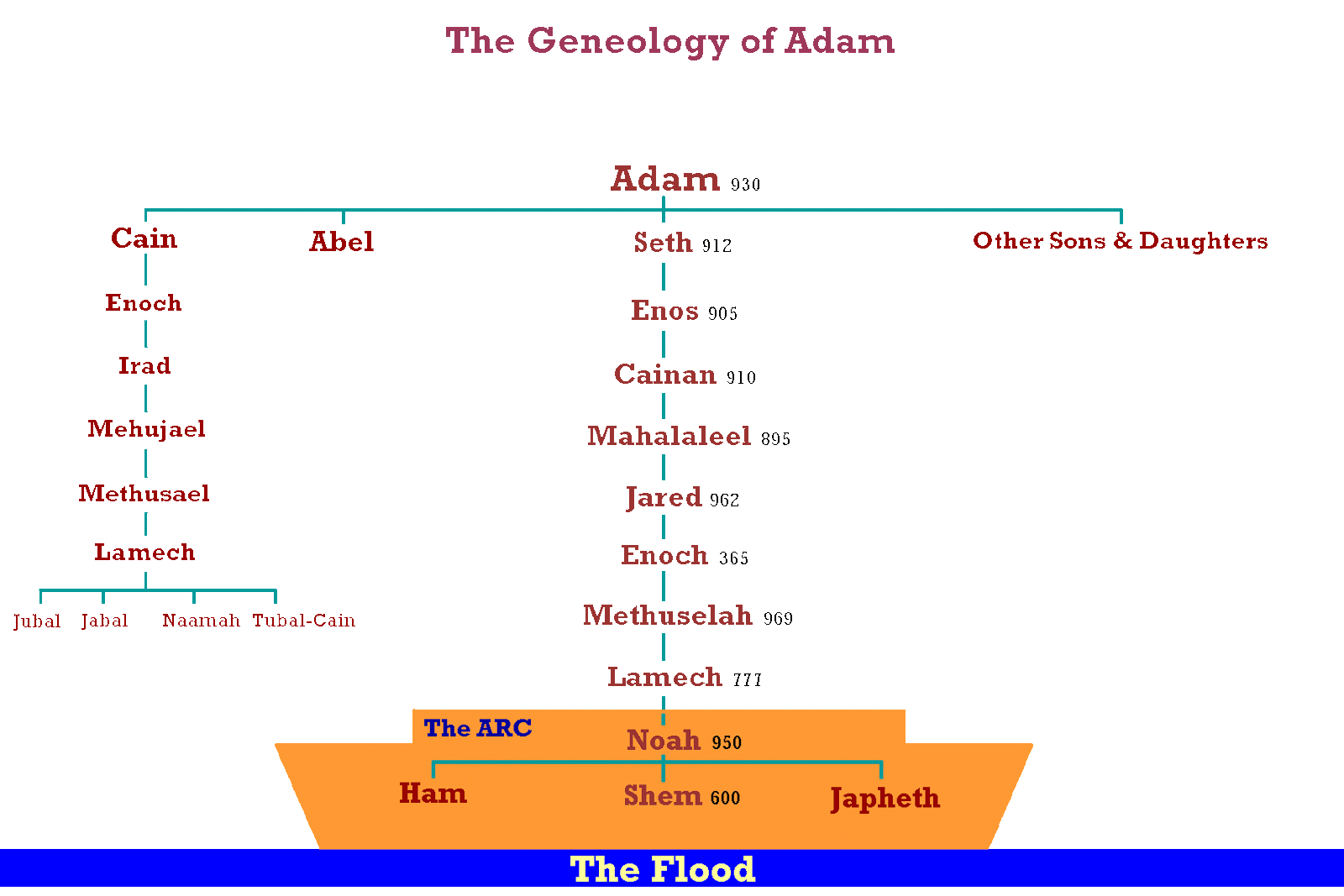
Question: Could the reference to the "sons of God" in Genesis 6:1-4
(v.2) refer to the line of Seth instead of disobedient angels, and the
daughters they married refer to the line of Cain? Wouldn’t that better explain
God's grief over their inter-marriage because the line of Cain’s unrighteous
descendants compromised Seth’s righteousness line?
This was
the position taken by John Calvin, among others, who wrote: “It
was, therefore, base ingratitude in the posterity of Seth, to mingle themselves
with the children of Cain” —EBC, in loc.
This interpretation assumes that
Scripture has clearly defined Seth’s family tree as a “holy line” and Cain’s
family tree as an “unholy line.” While it is true that Genesis 4:25 through
5:32 develops the ancestry of Noah (5:29-32) all the way back to Adam and Eve’s
son, Seth (Gen. 4:25), nothing is taught in these verses concerning a “holy” /
“righteous” line versus an “unholy” / “unrighteous” line.
More importantly, the wording in
Genesis 6:1-2 is intended to convey an obvious contrast between the “sons of God” and the “daughters of men” that resulted in the
appearance of the “Nephilim” (a race
of giants, as we saw in Biblegems #264) — “the
heroes of old, men of renown” (v.4). The phrase “sons of God” is never used in the Old Testament of the line of
Seth, before or after Genesis 6. “Sons of
God” is consistently used in the Old Testament, however, in reference to
angels, beginning with the book of Job—arguably one of the oldest books of the
Old Testament:
Job 1:6 Now there was a day when the sons of God
came to present themselves before the LORD, and Satan also came among them.
“Sons of God” here in Job, typical of Old Testament usage,
clearly refers to angels. Not only so, but the wording of Genesis 6:1-2 in
Hebrew conveys a sharp contrast between the “sons
of God” (Heb. “benei ha elohim”)
and “the daughters of humans” (Heb. “benot ha adaham”). A tightly literal
translation of Genesis 6:1-2 reads:
“When Adamites began to increase on the face
of the earth and daughters were born to them, the sons of Elohim saw the
daughters of Adam were pleasant and they took (Heb. yiqchu) any of them they chose.”
The most natural, straightforward
reading of the text contrasts the “sons
of God” with the “daughters of men”
as those representing two different lines of origin, not two lines of Adam.
Both the context and terminology
strongly favor the interpretation of “sons
of God” as referring to angels, not descendants of Cain. And while this
creates other issues scientifically and theologically, those issues also find
their answer in God’s Word. We will explore some of these difficulties in
future posts. And as we do, we will keep before us this guiding principle:
biblical interpretation is not the handmaiden of science. Science ceases where observation cannot go
and experimentation is no longer possible. God’s Word reveals the truth. At
times, the truth and scientific understanding seem at odds. When that is the
case, the truth will always win out and science may catch up…or not.
Deut. 29:29 The
secret things belong to the LORD our God, but the things revealed belong to us
and to our children forever, that we may follow all the words of this law.
