Showing posts with label John Calvin. Show all posts

Tuesday, April 12, 2016

Giants—Revisited Part 2, “Sons Of God”—The Line Of Seth?


Biblegems #266
Note: Bible Gems post #264, “Giants—Myth or History,” generated some excellent questions. Giants—Revisited Part 2 continues to explore these questions. While Bible Gems is not a debate forum, questions and comments are welcome and will be posted at the moderator’s discretion.


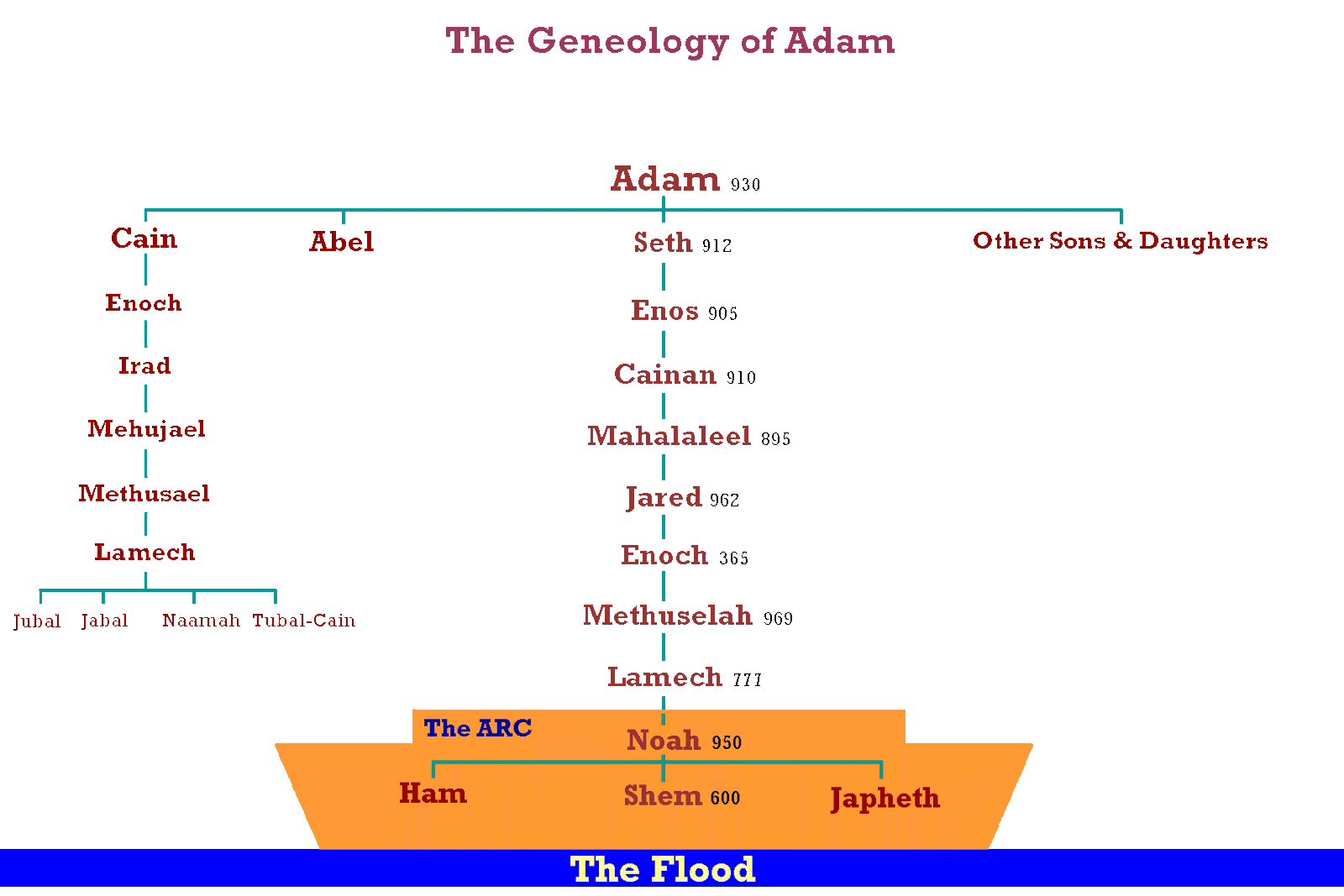
Question: Could the reference to the "sons of God" in Genesis 6:1-4 (v.2) refer to the line of Seth instead of disobedient angels, and the daughters they married refer to the line of Cain? Wouldn’t that better explain God's grief over their inter-marriage because the line of Cain’s unrighteous descendants compromised Seth’s righteousness line?

This was the position taken by John Calvin, among others, who wrote: “It was, therefore, base ingratitude in the posterity of Seth, to mingle themselves with the children of Cain” —EBC, in loc.

This interpretation assumes that Scripture has clearly defined Seth’s family tree as a “holy line” and Cain’s family tree as an “unholy line.” While it is true that Genesis 4:25 through 5:32 develops the ancestry of Noah (5:29-32) all the way back to Adam and Eve’s son, Seth (Gen. 4:25), nothing is taught in these verses concerning a “holy” / “righteous” line versus an “unholy” / “unrighteous” line.

More importantly, the wording in Genesis 6:1-2 is intended to convey an obvious contrast between the “sons of God” and the “daughters of men” that resulted in the appearance of the “Nephilim” (a race of giants, as we saw in Biblegems #264) — “the heroes of old, men of renown” (v.4). The phrase “sons of God” is never used in the Old Testament of the line of Seth, before or after Genesis 6. “Sons of God” is consistently used in the Old Testament, however, in reference to angels, beginning with the book of Job—arguably one of the oldest books of the Old Testament:
Job 1:6  Now there was a day when the sons of God came to present themselves before the LORD, and Satan also came among them.

“Sons of God” here in Job, typical of Old Testament usage, clearly refers to angels. Not only so, but the wording of Genesis 6:1-2 in Hebrew conveys a sharp contrast between the “sons of God” (Heb. “benei ha elohim”) and “the daughters of humans” (Heb. “benot ha adaham”). A tightly literal translation of Genesis 6:1-2 reads:
         “When Adamites began to increase on the face of the earth and daughters were born to them, the sons of Elohim saw the daughters of Adam were pleasant and they took (Heb. yiqchu) any of them they chose.”

The most natural, straightforward reading of the text contrasts the “sons of God” with the “daughters of men” as those representing two different lines of origin, not two lines of Adam.

Both the context and terminology strongly favor the interpretation of “sons of God” as referring to angels, not descendants of Cain. And while this creates other issues scientifically and theologically, those issues also find their answer in God’s Word. We will explore some of these difficulties in future posts. And as we do, we will keep before us this guiding principle: biblical interpretation is not the handmaiden of science.  Science ceases where observation cannot go and experimentation is no longer possible. God’s Word reveals the truth. At times, the truth and scientific understanding seem at odds. When that is the case, the truth will always win out and science may catch up…or not.
         Deut. 29:29  The secret things belong to the LORD our God, but the things revealed belong to us and to our children forever, that we may follow all the words of this law.

Tuesday, April 19, 2011

Music In Worship

Biblegems #35
Question: Could you address the historical / biblical role of music in worship?
The subject of music in congregational worship is huge, and there is no way it can be adequately covered in a 500-word Biblegems blog. So this article will be longer than most, yet still insufficient to cover the topic adequately. But I will attempt to present some highlights, which will hopefully spur interest in additional personal study.

As part of the Protestant Reformation, worship music composed by Martin Luther often took non-musical liturgies originally composed in Latin and translated them into the common language (German). He then put them to music, sometimes applying them to a familiar tune used by the Catholic church, sometimes using a Gregorian chant style, sometimes creating his own original melody, and often utilizing popular German folk tunes that the people already knew. To use a contemporary phrase, his desire was to make the music of worship “user friendly” to the people of his day.

In contrast to this, John Calvin, a contemporary of Luther’s, did not approve of Luther’s creative approach to church singing, but believed only Scripture put to music, with no harmony and no instruments, was appropriate for congregational worship. He was apparently unaware of the rich biblical heritage and instruction regarding the use of musical variety and creativity in worship.

Biblically, the purpose of corporate singing in worship is to provide an avenue or channel for people to enter God's presence—heart, soul, mind, body and spirit—in both reverential awe and joyful adoration.
Worship the LORD with gladness; come before him with joyful songs (Ps. 100:2).

Music stirs the emotions. It is supposed to, even in a worship service—perhaps, especially in a worship service. An important aspect of this is the use of musical instruments together with vocal praise:
Praise the LORD. Praise God in his sanctuary; praise him in his mighty heavens. Praise him for his acts of power; praise him for his surpassing greatness. Praise him with the sounding of the trumpet, praise him with the harp and lyre, praise him with tambourine and dancing, praise him with the strings and flute, praise him with the clash of cymbals, praise him with resounding cymbals. Let everything that has breath praise the LORD. Praise the LORD (Ps. 150:1-6).

In the New Testament, God’s Word says we are to… Speak to one another with psalms, hymns and spiritual songs. Sing and make music in your heart to the Lord (Eph. 5:19; cf. Col. 3:16). The verb “to speak” (laleo) refers to singing as well as speech, and even is used of the sound created by instruments. So the Bible is telling us to fill our times together with all different kinds of music—psalms, hymns, and songs. (Arndt & Gingrich’s Greeek / English Lexicon, in loc.)

Music was an important part of New Testament worship, both congregationally and spontaneously (Matt. 26:30; 1Cor. 14:26; Acts 16:25; Rom. 15:9). “Psalms, hymns and spiritual songs” actually allude to types of music practiced by the early Christians.

Psalms” refers to the Old Testament Psalms, which were integrated with Christian worship from the earliest days. The verb “to make music” (Eph. 5:19) is psallo, from which we get our English word “psalm.” Literally, psallo means “to pluck,” a reference to stringed instruments or praise songs to the accompaniment of stringed instruments. (Ref., EBC, Frank Gaebelin; Arndt & Gingrich’s Greeek / English Lexicon).

Hymns(‘’umnos: “songs of praise”) was a term used in pagan worship to praise some god or cultic hero. Christians adopted the word to describe songs that exalted the name of Jesus or God. Examples appear in the both the Old Testament (Ps. 40:3) and the New (Phil. 2:5-11).

“Spiritual songs” (odai pneumatikai) is a term intended to distinguish Christian music from secular music that may have sounded very similar. The term odai (“songs”) originally referred to secular music. The New Testament adopted the term to refer to songs of praise to God or Christ. “Spiritual songs” can also designate spontaneous singing in the Spirit.

Much of what the Church today considers “hymns” were once the “spiritual songs” adopted from the secular music styles of the day. “There Is A Fountain” and “Yesterday, Today, Forever” are both prime examples of 18th-19th century English & American traditional / folk styles that have been immortalized in our hymnals. The well-known Christmas carol, “Go, Tell It On The Mountain,” is an African American Spiritual of the same period. “O Sacred Head Now wounded” comes from the “Baroque” style of the 17th century, while “Joyful, Joyful, We Adore Thee” reflects the classical musical style of the 18th century. “What Child Is This” was taken wholesale and adapted from the Medieval folk song “Green Sleeves.”
Music in worship has always reflected the cultures and styles in which believers have found themselves. Worship music has been the music of the people because it is the music these people grew up with, knew and loved. What could be more natural—or spiritual— than to “baptize” the music of their time with their newfound love for Jesus?

God desires that worship be heart-felt and sincere, not defined by human traditions (old or new) that reduce worship to liturgical patterns (or the lack thereof) or styles or instruments or language preference:
The Lord says: “These people come near to me with their mouth and honor me with their lips, but their hearts are far from me. Their worship of me is made up only of rules taught by men (Is. 29:13).

Some forms of music and types of instruments are especially well suited for arousing emotions of excitement, joy, adoration, directing those emotions to God. Worship music in Bible times included a great variety of instruments: Horns (Da 3:5, 7, 10), Cymbals (1Chr. 15:19, 28; 1Cor. 13:1), Flutes (Gen. 4:21; Dan. 3:5, 7, 10, 15), Gittiths, possibly a stringed instrument (Ps. 8; 81), Harps (1Sam. 10:5; 16:16, 23; 1Chr. 16:5), Lyres (1Chr. 16:5), Pipe (1Sam. 10:5; Is. 30:20; Dan. 3:5, 10, 15), Sistrum (2Sam. 6:5), Tambourines (i.e., drums with bells. Ex. 15:20), Trumpets (Josh. 6:4) and Zithers (Dan. 3:5, 7, 10, 15). All of these and more provided a lively, energetic background to the crescendo of praise pouring from the hearts and lips of God’s people.

The sheer volume of voices and instruments can stir the emotions and elicit a sense of awe appropriate to engaging people in the worship of God:
Four thousand are to be gatekeepers and four thousand are to praise the LORD with the musical instruments I have provided for that purpose (1 Chr. 23:5; 1 Chr. 23:5).

It is with such vibrant, loud and exciting music that the saints of all the ages will gather around the Throne of God and of the Lamb, declaring their love and adoration throughout eternity:
Then I heard what sounded like a great multitude, like the roar of rushing waters and like loud peals of thunder, shouting: “Hallelujah! For our Lord God Almighty reigns (Rev. 19:6).