Showing posts with label Cain. Show all posts

Tuesday, May 10, 2016

The Book Of Enoch


Biblegems #268


Jude 14-15  Enoch, the seventh from Adam, prophesied about them: “See, the Lord is coming with thousands upon thousands of his holy ones to judge everyone, and to convict all of them of all the ungodly acts they have committed in their ungodliness, and of all the defiant words ungodly sinners have spoken against him.

Enoch was Cain’s first son, and also the name of the world’s first city, which Cain named after his son (Gen. 4:17). The prophecy of Enoch mentioned in Jude is found in First Enoch (the first book in a collection of five known today as Ethiopic Enoch).  While the writing of the existing manuscripts dates back to the 3rd century to 1st century B.C., the original content is presumed to extend all the way back to Enoch himself.

The Book of Enoch was widely read in Jewish and Christian circles in New Testament times, and portions of all but Book Two have been found among the other ancient Dead Sea scrolls in the Qumran caves. First Enoch, or “The Book Of The Watchers,” quoted by Jude builds on the account in Genesis 6:1-4 of the “sons of God” uniting with the “daughters of men,” resulting in the offspring of giants. The “sons of God” are identified in Enoch as a band of angels (called “Watchers”) who are captured by angels sent from God and imprisoned until the Final Judgment. Jude’s quote from First Enoch (see above) refers to the Day of the Lord and the outpouring of His wrath upon rebellious mankind prior to that Final Judgment Day.

While the Book of Enoch is not inspired Scripture, God in His sovereign wisdom did inspire Jude to quote from it. God used a book that was popular among Christians in the first century, including the apostles, to convey certain truths about the End Times. That does not validate everything written in the Book of Enoch. On the other hand, the New Testament does refer to a specific group of angels who:
Jude 6  did not keep their positions of authority but abandoned their proper dwelling—these he has kept in darkness, bound with everlasting chains for judgment on the great Day

And of—
         1Pet. 3:19b-20a  imprisoned spirits—to those who were disobedient long ago when God waited patiently in the days of Noah while the ark was being built.

And…
         2Pet. 2:4   For if God did not spare angels when they sinned, but cast them into hell (Lit., “Tartarus,” which means “pits”) and committed them to chains of gloomy darkness to be kept until the judgment.

This descriptive language borrowed directly from First Enoch compares Enoch with the crucified and risen Christ. Enoch had been sent to the rebellious, imprisoned angels to pronounce God’s judgment. When they asked Enoch to beg God’s mercy on their behalf, God responded with the same declaration of judgment. In 1 Peter 3:19, Jesus, crucified but made alive by the Spirit, preached” (Lit., “made a proclamation”) to these imprisoned spirits: He is the true Enoch (by comparison) who walks with God, and has overcome sin, death and all the demonic powers of evil. In the words of the apostle Paul:
         Phil. 2:10   that at the name of Jesus every knee should bow, in heaven and on earth and under the earth


Tuesday, April 12, 2016

Giants—Revisited Part 2, “Sons Of God”—The Line Of Seth?


Biblegems #266
Note: Bible Gems post #264, “Giants—Myth or History,” generated some excellent questions. Giants—Revisited Part 2 continues to explore these questions. While Bible Gems is not a debate forum, questions and comments are welcome and will be posted at the moderator’s discretion.


Question: Could the reference to the "sons of God" in Genesis 6:1-4 (v.2) refer to the line of Seth instead of disobedient angels, and the daughters they married refer to the line of Cain? Wouldn’t that better explain God's grief over their inter-marriage because the line of Cain’s unrighteous descendants compromised Seth’s righteousness line?

This was the position taken by John Calvin, among others, who wrote: “It was, therefore, base ingratitude in the posterity of Seth, to mingle themselves with the children of Cain” —EBC, in loc.

This interpretation assumes that Scripture has clearly defined Seth’s family tree as a “holy line” and Cain’s family tree as an “unholy line.” While it is true that Genesis 4:25 through 5:32 develops the ancestry of Noah (5:29-32) all the way back to Adam and Eve’s son, Seth (Gen. 4:25), nothing is taught in these verses concerning a “holy” / “righteous” line versus an “unholy” / “unrighteous” line.

More importantly, the wording in Genesis 6:1-2 is intended to convey an obvious contrast between the “sons of God” and the “daughters of men” that resulted in the appearance of the “Nephilim” (a race of giants, as we saw in Biblegems #264) — “the heroes of old, men of renown” (v.4). The phrase “sons of God” is never used in the Old Testament of the line of Seth, before or after Genesis 6. “Sons of God” is consistently used in the Old Testament, however, in reference to angels, beginning with the book of Job—arguably one of the oldest books of the Old Testament:
Job 1:6  Now there was a day when the sons of God came to present themselves before the LORD, and Satan also came among them.

“Sons of God” here in Job, typical of Old Testament usage, clearly refers to angels. Not only so, but the wording of Genesis 6:1-2 in Hebrew conveys a sharp contrast between the “sons of God” (Heb. “benei ha elohim”) and “the daughters of humans” (Heb. “benot ha adaham”). A tightly literal translation of Genesis 6:1-2 reads:
         “When Adamites began to increase on the face of the earth and daughters were born to them, the sons of Elohim saw the daughters of Adam were pleasant and they took (Heb. yiqchu) any of them they chose.”

The most natural, straightforward reading of the text contrasts the “sons of God” with the “daughters of men” as those representing two different lines of origin, not two lines of Adam.

Both the context and terminology strongly favor the interpretation of “sons of God” as referring to angels, not descendants of Cain. And while this creates other issues scientifically and theologically, those issues also find their answer in God’s Word. We will explore some of these difficulties in future posts. And as we do, we will keep before us this guiding principle: biblical interpretation is not the handmaiden of science.  Science ceases where observation cannot go and experimentation is no longer possible. God’s Word reveals the truth. At times, the truth and scientific understanding seem at odds. When that is the case, the truth will always win out and science may catch up…or not.
         Deut. 29:29  The secret things belong to the LORD our God, but the things revealed belong to us and to our children forever, that we may follow all the words of this law.

Tuesday, January 15, 2013

Who Was Cain Afraid Of?


Biblegems #118
Question: After God banishes Cain for killing his brother Abel in Genesis 4, Cain complains that others on the earth will kill him for his crime when they find him (Gen. 4:13-14). Who are the others on the earth at that time that Cain is afraid of? Where did these other people come from?

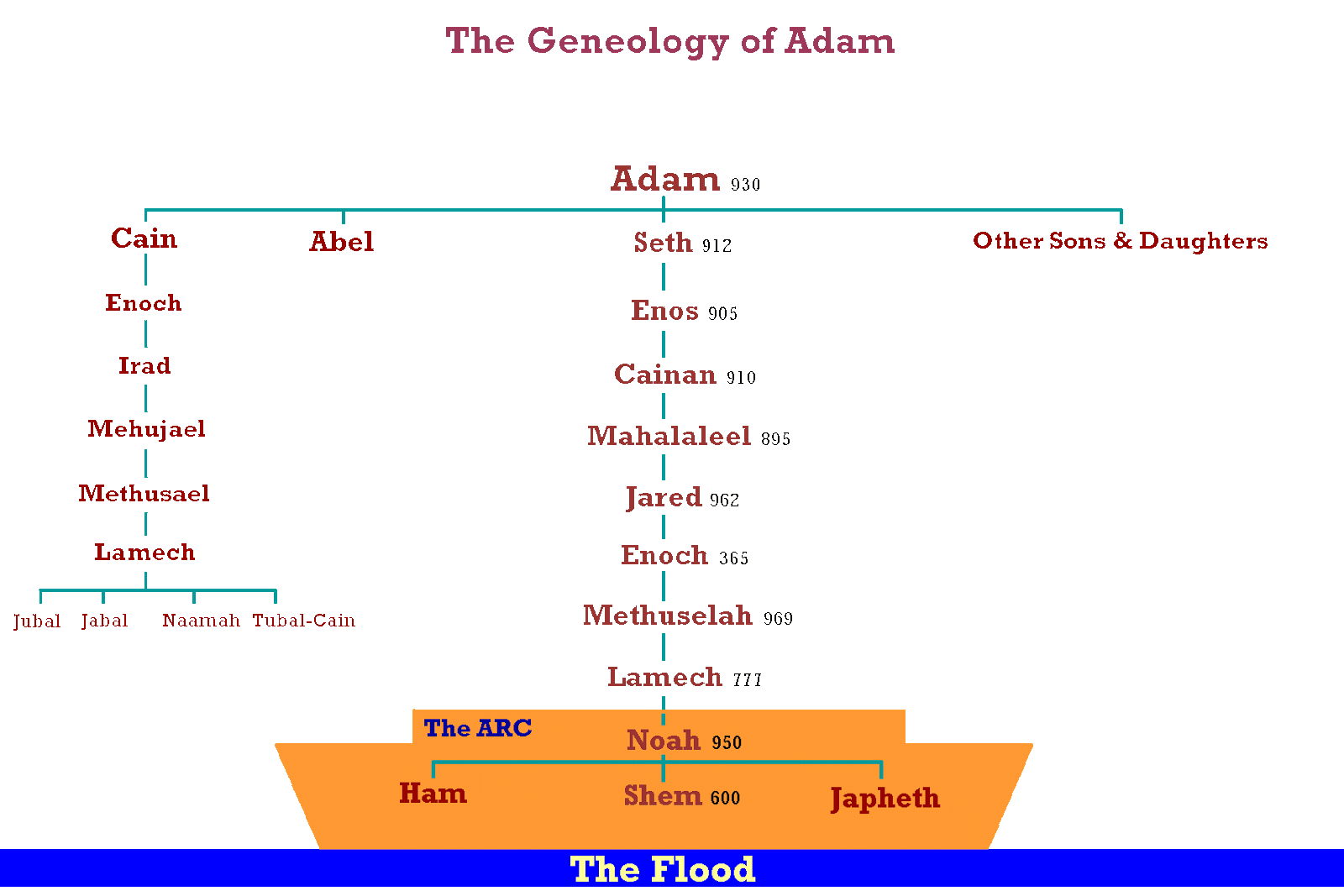
Adam and Eve, the ancestors of the human race, and their children, Cain and Abel, were real, historical people. In addition to Cain and Abel, Adam and Eve had many other children  (Gen 5:4). And in the 930 years of Adam’s life (Gen. 5:5), these children grew up, intermarried, and had children of their own, resulting in a population of at least one hundred and twenty thousand people by the time of Adam’s death. We know from Scripture that these descendants of Adam and Eve spread out and established settlements all over the ancient Near East. 

Reading Genesis 4 -5 can be deceptive when it comes to following the passage of time. But a careful reading can be very revealing. For instance, chapter 4:1-2 takes us from the conception and birth of Cain and Abel right into their adulthood. By the end of verse two they are both living independent of their parents and working at their respective occupations. Abel is murdered in verse eight; and by verse sixteen Cain is in exile in “the land of Nod, east of Eden.” Then, in the very next verse, Cain has found a wife, who gets pregnant and has his child, Enoch—all while Cain is building a city, which he names after his son.

The point is, the account of Cain and Abel moves quickly from one key event to another. This is to show that within the first thousand years of human history God’s command to Adam and Eve to Be fruitful and increase in number; fill the earth and subdue it” (Gen. 1:28) was already well under way. Thousands of people—the descendants of Adam and Eve—populated the earth, farmed the land, tended livestock, constructed cities, and brought with them the plague of sin and death.

So it is clear that Cain and Abel had many brothers and sisters, most of whom had hundreds of years of separation between them. In fact, in the “written account of Adam’s line” (Gen. 5:1) Cain and Abel are not even mentioned, nor are any of their siblings except Seth. Why? Because Seth represents the ancestral line of Noah (Gen. 5:28-29), who played a principal role in God’s plan of salvation. All the descendants of all the other siblings of Cain and Abel were lost in the Flood, except those who married into Noah’s family and were aboard the ark.

So who was Cain afraid of when he went into exile? His own brothers and sisters and their extended families. The same is true for all of us, for we are all related to one another, only separated by time, distance and multiple layers of intermarriage. We are one family—the human family—and each person’s sin impacts the rest of the family. That’s why salvation from sin and death had to come through a human being, but one who was without sin.
         1 Cor. 15:21 For since death came through a man, the resurrection of the dead comes also through a man.
The death and resurrection of Jesus has reversed the curse of Adam and Cain!